


Synopsis: Cloud kitchens are reshaping India’s food economy through logistics-led infrastructure, where urban warehousing and logistics parks enable proximity to demand. Integrated with dark stores and last-mile logistics networks, these facilities improve delivery speed, operational efficiency, and scalability. As cities densify, strategically located in-city logistics parks are becoming critical infrastructure for time-sensitive food delivery ecosystems.
Introduction
India’s food story has always been rich, emotional, and deeply personal. What has changed in recent years is not the love for food, but the system that delivers it. The rise of cloud kitchens marks a structural shift in how food businesses are built, scaled, and sustained in Indian cities. What looks like a culinary trend is, in reality, a story of infrastructure, logistics, and urban proximity.
At Horizon, we view cloud kitchens not as a passing format but as a long-term reorganisation of the food economy – one where location replaces frontage, speed replaces seating, and in-city infrastructure becomes the silent growth engine.
How Are Cloud Kitchens Shifting Restaurants from Dining Rooms to Distributed Urban Warehousing Networks?
For decades, restaurants were designed around visibility. Success depended on its location on busy streets, walk-in footfall, and the theatre of dining. Cloud kitchens reversed that logic entirely. They removed the dining room, eliminated the cost of visibility, and repositioned the kitchen closer to where demand actually lives.
This shift aligned perfectly with the rise of food delivery platforms such as Swiggy and Zomato, which didn’t just aggregate restaurants – they reshaped consumer behaviour. Speed, reliability, and choice became the new benchmarks. The question was no longer where is the restaurant? but how fast can the food reach me?
Cloud kitchens emerged as the most efficient answer to that question.
Why Does the Cloud Kitchen Model Fit India’s Urban Warehousing and Last-Mile Logistics Needs So Precisely?
Indian cities are dense, complex, and uneven. Consumption does not flow uniformly across a city; it clusters around residential pockets, office districts, healthcare hubs, student zones, and high-activity neighbourhoods. A single dine-in outlet can only capture a fraction of this demand. A strategically located cloud kitchen, however, can serve multiple high-density clusters within a tightly defined delivery radius.
There is also a strong behavioural dimension. Indian consumers are experimental yet discerning. They are willing to try new cuisines and brands but expect consistency, affordability, and speed. Cloud kitchens allow operators to respond to this dynamic reality – testing menus, launching virtual brands, and fine-tuning offerings without the fixed costs and risks of traditional restaurants.
This is precisely how companies like Rebel Foods, EatClub, Curefoods, Box8 scaled rapidly across cities. Their success was not driven by novelty alone, but by leveraging a unified tech platform for centralised kitchen management, inventory, data, and catering to diverse audience through numerous distinct brands. They place kitchens where demand density, delivery time, and operational efficiency intersect. This model enables rapid scaling, innovation, and partnerships (for example, Rebel Launcher) for other food brands, creating a highly efficient, data-backed, and scalable food delivery business.

How Are Cloud Kitchens Built on Last-Mile Logistics and Urban Warehousing Infrastructure?
Strip away the branding and menus, and a cloud kitchen reveals its true nature: it is a time-sensitive logistics operation.
Raw materials must flow in predictably. Storage, waste, and hygiene must be managed without friction. Delivery partners need quick, safe, and repeatable access. Peak-hour congestion can determine ratings, repeat orders, and profitability. In this environment, even small inefficiencies compound quickly.
This is why cloud kitchens behave less like restaurants and more like urban distribution nodes – urban warehousing. Their success depends on the same fundamentals that drive modern logistics – location, access, circulation, compliance, and scalability.
And this is where cloud kitchen infrastructure stops being a background decision and becomes a competitive advantage.
How Do Horizon InCity Centers Faster Food Delivery?
Cloud kitchens are no longer standalone entities. They increasingly operate alongside quick-commerce dark stores, micro-fulfilment centres, and last-mile logistics hubs. Food, retail, and logistics are converging into a single urban consumption stack – one that prioritises speed, reliability, and proximity.
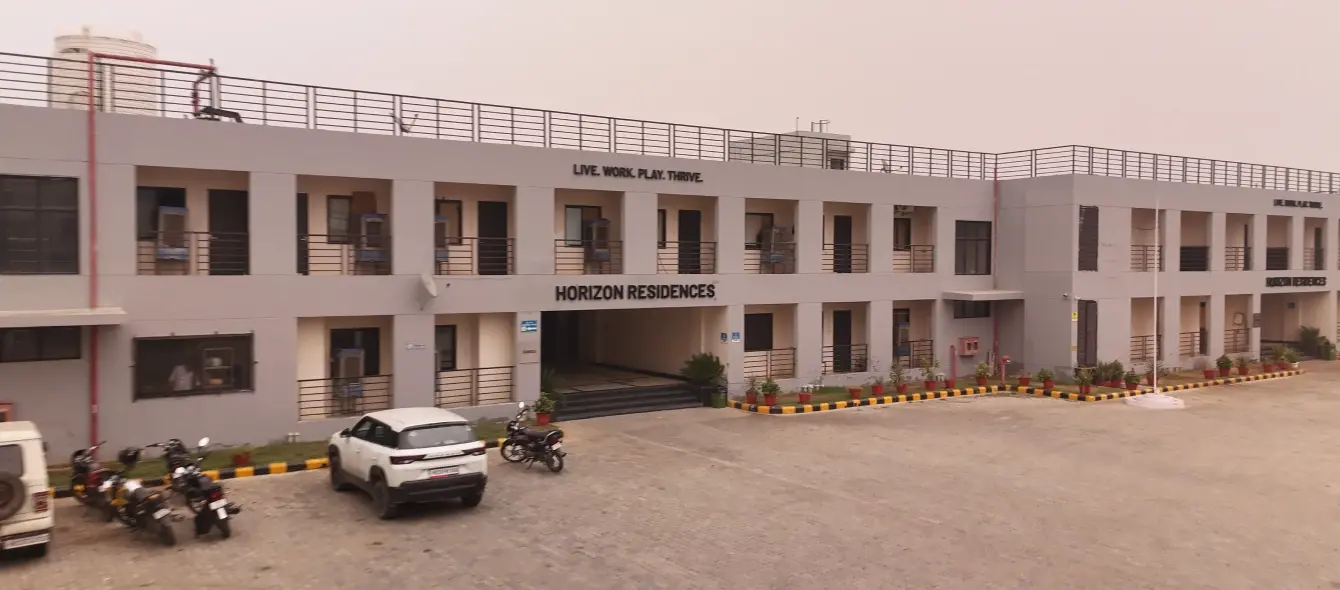
Horizon InCity Centers are multi-use urban warehousing facilities located around dense residential clusters enabling close proximity to consumers. They provide access to a ready market of over 20 million end-consumers located within a 10 to 30-minute driving distance. We see cloud kitchens as a core part of the in-city consumption ecosystem. Food delivery is among the most time-critical categories in urban logistics, and it demands infrastructure that is fundamentally different from peripheral warehousing or high-street retail.
-
- In-city location is the first multiplier.
Being closer to consumption clusters directly reduces delivery times, improves order density, and lowers rider fatigue and cost. For cloud kitchens, this proximity translates into better unit economics and stronger customer experience – without increasing marketing spends or discounts. - Access is the second multiplier.
Cloud kitchens operate in short, intense bursts of activity. Lunch and dinner peaks leave no room for congestion or poor circulation. Horizon’s in-city centres are designed to support high-frequency movement, with clear access for inbound supplies and rapid turnaround for outbound deliveries. This operational ease often becomes the difference between surviving and scaling. - Compliance and institutional reliability form the third layer.
As cloud kitchens mature, regulatory scrutiny increases. Food safety, fire norms, waste management, and labour compliance can no longer be managed in ad-hoc setups. Operating from organised, compliant infrastructure allows brands to scale with confidence and reduces long-term risk. Horizon’s in-city assets provide this institutional backbone – enabling operators to focus on their growth. - Scalability completes the picture.
Today’s cloud kitchen may be a single brand. Tomorrow, it could house multiple cuisines and brands, integrate quick commerce, or expand into institutional catering. Horizon’s in-city centres are built to accommodate this evolution, allowing operators to grow within the same ecosystem in a logistics park as their business model matures, with flexible and scalable spaces.
- In-city location is the first multiplier.
What Is the Next Phase for Cloud Kitchens in Logistics Parks and Urban Warehousing?
The future of cloud kitchens in India will not be defined by how many kitchens exist, but by how intelligently they are placed. As competition intensifies and margins tighten, operators will favour locations that offer operational resilience over mere expansion.
Data-led site selection, stricter compliance norms, and deeper integration with last-mile networks will make high-quality in-city infrastructure not just desirable, but essential. The winners will be those who recognise that growth is no longer about opening more kitchens – it’s about opening the right kitchens.
Why Will Logistics Parks, Dark Stores, and Last-Mile Logistics Shape the Future of Cloud Kitchens?
The cloud kitchen revolution is often framed as a story of food and technology. In reality, it is a story of cities – and how efficiently they move goods, people, and services.
At Horizon, we believe the future of food delivery in India will be shaped by infrastructure that understands urban rhythms and operates at their pace. Because in a delivery-first world, the most powerful ingredient is not on the menu. It’s in the location and efficient design.