




Synopsis: India’s manufacturing ambitions are accelerating. The country aims to raise the sector’s contribution to GDP from approximately 17% to 25% by 2047 – a target that would require generating up to 120 million manufacturing jobs by 2033 and absorbing millions of workers into large-scale industrial clusters. Yet one of the most critical enablers of this scale remains under-addressed: where the workforce lives. In many industrial clusters, workers lose up to four hours daily commuting from informal housing, creating compounding losses in productivity, attendance, and retention. Recognising this, NITI Aayog’s S.A.F.E. (Site Adjacent Factory Employee) Accommodation framework has identified workforce housing as essential infrastructure for manufacturing growth – estimating a national requirement of approximately 25 million organised housing units. This blog examines why staff accommodation is not a welfare initiative but operational infrastructure – one that directly determines plant productivity, workforce stability, and India’s competitiveness as a global manufacturing destination.
What Is The Scale of India’s Manufacturing Workforce Challenge?
India’s manufacturing sector stands at an inflection point. The government has set a target to increase manufacturing’s contribution to GDP from approximately 17% to 25% by 2047 (NITI Aayog – SAFE Report). Achieving this requires the sector to grow at approximately 11% per annum, accompanied by a 1.5x increase in workforce productivity. By 2033, this trajectory is expected to generate up to 120 million manufacturing jobs (PIB).
These jobs will increasingly concentrate in large industrial clusters – Grade A logistics parks, manufacturing hubs, and special economic zones – where the concentration of related industries creates economies of scale. In such clusters, labour demand far exceeds what nearby towns and villages can supply, drawing workers from across regions and states.
Yet while industrial development has traditionally focused on land, infrastructure, and connectivity, one critical planning factor remains systematically overlooked: where this workforce will live. Without structured accommodation solutions near industrial clusters, the workforce bottleneck will constrain the very expansion that Make in India, PLI schemes, and Viksit Bharat are designed to enable.
What Constitutes The Productivity Cost of Distance?
The link between worker housing and operational performance is more direct than it might appear. Research from industrial areas near Bangalore reveals that workers travelling approximately two hours each way from temporary residences lose nearly four hours daily in transit – while employers absorb monthly transportation costs of around ₹5,000 per worker (FED – Worker Housing Report). This is not merely an inconvenience. Four hours of daily commuting produces fatigue that compounds across shifts, erodes punctuality, and raises the likelihood of unplanned absence.
The data confirms this. Absenteeism in Indian manufacturing averages around 11% on any given day and can reach 20% in some facilities. Each percentage point of absence ripples through production schedules, increases dependence on contract labour, and drives recurring costs in recruitment and retraining.
Living conditions amplify the problem. Workers in informal settlements or overcrowded rooms face higher rates of illness and limited recovery between shifts – factors that affect not just attendance but the quality and consistency of output. For occupiers running high-throughput operations in warehouses or factories, this variability is a direct constraint on operational reliability.
Research published in the Journal of Political Economy further demonstrates that Indian manufacturing workers show reduced productivity and increased absenteeism under conditions of poor housing and environmental stress – with annual plant output falling measurably as worker welfare declines (Somanathan et al., 2021).
What It Takes For Workforce Retention?
High attrition is a persistent and expensive challenge across India’s manufacturing clusters. Workers commuting long distances or living in unstable, informal housing are significantly more likely to shift jobs – creating recurring cycles of recruitment, onboarding, and retraining that drain operational resources.
The costs are not limited to HR budgets. In a manufacturing facility running three shifts, high attrition means:
- A permanent capacity gap as positions remain unfilled or staffed by insufficiently trained replacements
- Greater variability in output quality as rotating workers lack familiarity with processes and equipment
- Higher dependence on contract labour, which reduces operational control and increases per-unit costs
- Disrupted production scheduling, particularly during peak demand periods
Stable accommodation close to the workplace addresses these challenges structurally. When workers have access to safe, organised housing within proximity of the industrial park, commute-related fatigue is eliminated, the incentive to remain with an employer strengthens, and companies can invest in skill development with confidence that the workforce will stay long enough to deliver returns on that investment.
In labour-intensive manufacturing and logistics operations, workforce stability is not a welfare metric – it is a production metric.
What Is The S.A.F.E. Framework: The National Policy Meeting Industrial Reality?
The need for structured workforce accommodation is now formally recognised at the highest levels of policy. In December 2024, NITI Aayog released its report on S.A.F.E. (Site Adjacent Factory Employee) Accommodation – a comprehensive framework that identifies worker housing as a strategic imperative for India’s manufacturing growth (NITI Aayog – SAFE Report).
The report’s key findings and recommendations include:
- Scale of demand: If even 20% of the projected manufacturing workforce in 2033 seeks affordable formal accommodation, India would need approximately 25 million organised housing units
- Budget alignment: The Union Budget 2024-25 emphasised dormitory-style rental housing for industrial workers under a Public-Private Partnership (PPP) model with Viability Gap Funding (VGF) covering 30-40% of project costs
- Regulatory reform: Reclassifying worker accommodations as a distinct residential housing category to enable residential utility tariffs, amending zoning laws to permit mixed-use development near industrial hubs, and streamlining environmental clearances
- Gender-inclusive design: Promoting housing solutions that specifically address the safety and welfare of female workers – a critical factor for expanding women’s participation in manufacturing
- Global benchmarking: The report notes that China’s manufacturing success was supported by integrated worker housing, with 80% of assembly line workers (predominantly women) receiving accommodation as part of their employment. Vietnam has committed to building 1 million housing units for workers in industrial parks. Singapore has built 43 dormitories housing 200,000 migrant workers
The S.A.F.E. framework signals a fundamental policy shift: workforce accommodation is no longer an amenity. It is essential infrastructure – as critical to manufacturing competitiveness as roads, power, and logistics connectivity.
How Goes It From Industrial Clusters to Human Centric Industrial and Logistics Parks?
The S.A.F.E. framework articulates what progressive industrial park developers have already begun implementing: the integration of workforce living solutions into the core design of human centric industrial parks.
This represents a fundamental evolution in how industrial parks are conceived. Traditional industrial development treated parks as clusters of factories and warehouses, with workforce accommodation left to the unregulated local market. The result – informal settlements, overcrowded rental rooms, and multi-hour commutes – is well-documented.
The next-generation model treats the industrial park as an integrated ecosystem, where logistics infrastructure, utilities, sustainability systems, and workforce facilities in industrial parks are planned together. This means:
- Site-adjacent accommodation that reduces commute times from hours to minutes, translating directly into better rest, improved punctuality, and greater availability across shifts
- Essential amenities within the park ecosystem – medical rooms, healthcare access, sanitation facilities, food services, and convenience retail – that reduce the daily friction workers face in accessing basic services
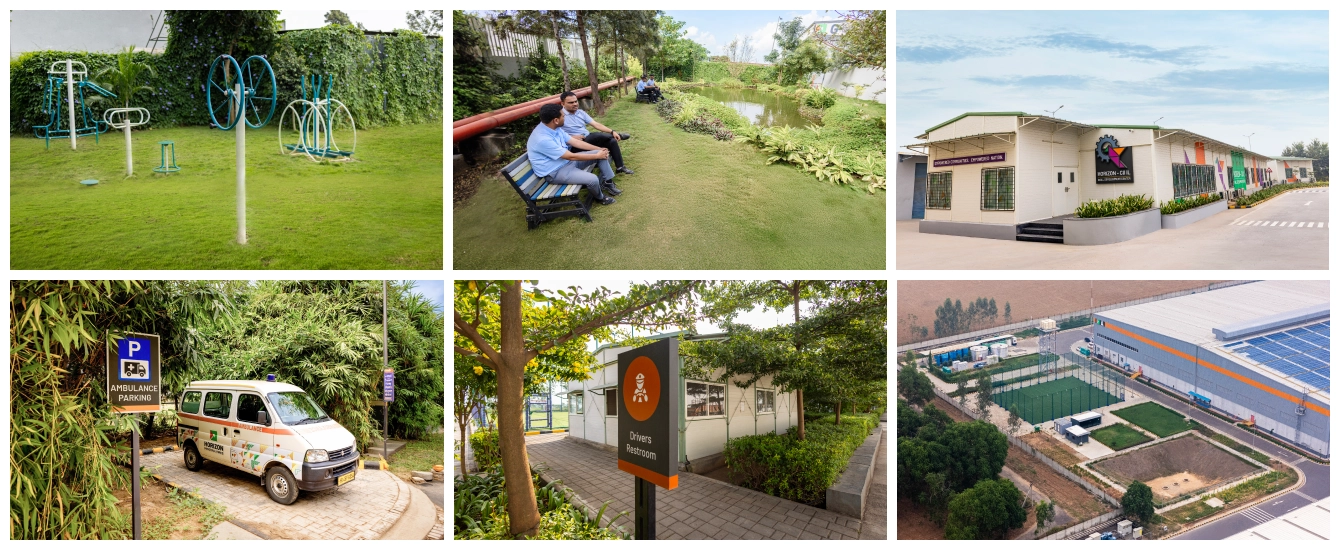
- Recreation and wellness infrastructure – multi-sports arenas, landscaped green spaces, shaded rest zones, and meditation areas – that support physical and mental recovery between shifts
- Skill development centres that enable continuous upskilling within the park environment, improving both workforce capability and retention
- Gender-sensitive design – including separate sanitation facilities, safe housing configurations, and accessible layouts – that enable a more diverse workforce
When a logistics park with staff accommodation or a warehouse with staff accommodation is designed as part of an integrated human centric park, the distance between where people live and where they work shrinks from a structural constraint to a deliberate design advantage.
What Is The Business Case?
Staff accommodation in industrial parks is not a CSR initiative. It is operational infrastructure with a quantifiable return on investment.
The business case operates at multiple levels:
- Productivity: Even marginal reductions in absenteeism – from the 11-20% range to single digits – tighten the entire operational cycle. Production scheduling becomes more reliable, overtime costs decrease, and output consistency improves
- Cost reduction: Eliminating or reducing the ₹5,000+ monthly per-worker transportation subsidy, combined with lower recruitment and retraining costs from reduced attrition, creates direct savings that offset accommodation investment
- Quality: A stable, rested workforce produces more consistent output. In sectors where quality variance has direct commercial consequences – automotive components, electronics, pharmaceuticals, FMCG – workforce stability is a quality control lever
- Shift coverage: Proximity-based accommodation ensures consistent workforce availability across all shifts, including night and early morning shifts where commute-dependent workers are most likely to be absent or late
- Global competitiveness: Multinational corporations and global investors increasingly evaluate workforce welfare and operational resilience when selecting manufacturing locations. High-quality worker accommodation signals alignment with international labour standards – a factor that can determine where global supply chains choose to operate (The Secretariat)
For Grade A logistics parks competing to attract anchor tenants and multinational occupiers, integrated workforce housing is moving from a differentiator to a prerequisite.
What Successful Manufacturing Hubs Got Right To Set Global Precedents?
India is not the first country to confront the workforce housing challenge at scale. The manufacturing hubs that successfully industrialised in Asia integrated worker housing into their industrial planning from the outset (FED Report):
- China: 80% of assembly line workers – predominantly women – received accommodation as part of their employment contracts. Dormitory-style housing within or adjacent to factory complexes was a standard feature of China’s export manufacturing model
- Vietnam: The government has committed to building 1 million housing units for low- and middle-income households and workers in industrial parks, recognising that housing availability directly influences Vietnam’s attractiveness to FDI
- Singapore: 43 purpose-built dormitories house approximately 200,000 migrant workers from the construction and manufacturing sectors, with regulated standards for living space, amenities, and safety
- Japan: Textile industries historically housed female labour from distant villages in dormitory accommodation, enabling labour mobility that supported rapid industrialisation
The common lesson is clear: countries that treated worker housing as industrial infrastructure – not as a market externality – were able to scale manufacturing faster, attract more investment, and maintain workforce stability. India’s adoption of the S.A.F.E. framework signals that this lesson is now being internalised at the policy level.
How Is Horizon Building Human Centric Industrial Parks?
At Horizon Industrial Parks – India’s largest pure-play industrial and logistics platform – the integration of workforce infrastructure is a core design principle, not an afterthought.
Across its 45 parks nationwide, Horizon is building human centric industrial and logistics parks that combine operational infrastructure with workforce facilities in industrial parks:
- Staff accommodation integration – blue-collar and white-collar housing within or adjacent to park ecosystems, reducing commute times from hours to minutes
- Medical rooms and 24×7 ambulance services to address health needs with speed and care, complemented by regular health camps and safety training
- Multi-sports arenas integrated into park design, enabling workers to unwind and recharge physically
- Convention centres, food courts, and convenience retail that reduce the daily friction of accessing basic services
- Skill Development Centres launched in partnership with CII, training youth in warehousing operations, logistics processes, and industrial safety practices – with 100% job placement support
- Green, calming spaces – including Miyawaki urban forests, butterfly gardens, shaded seating areas, and tree-lined pathways – with at least 15% of every park dedicated to landscaped areas
- Barrier-free, accessible design – dedicated pedestrian walkways, wayfinding signage, and ramps ensuring people of all abilities can navigate the park safely
- Drivers’ rest areas for long-haul drivers, reducing fatigue-related risks during loading and unloading operations
This approach aligns with the S.A.F.E. framework’s vision: industrial parks that function as integrated ecosystems where businesses operate at scale, workforces live with dignity, and the distance between the two is measured in minutes, not hours.
Is Staff Accommodation The Foundation of India’s Manufacturing Future?
India’s manufacturing expansion will not be constrained by a shortage of policy ambition, capital, or demand. It is far more likely to be constrained by the availability and stability of a productive workforce – and that, in turn, depends on where workers live.
The S.A.F.E. framework has made the case at the national level. The global evidence is unambiguous. And the operational data from India’s own industrial clusters confirms what progressive developers have already begun acting on: staff accommodation is not an amenity bolted onto an industrial park after the fact. It is a core planning consideration that determines whether a park can function as a genuinely integrated, human centric industrial ecosystem.
As India moves toward its Viksit Bharat goals, the distance between where people live and where they work will increasingly determine the pace of industrial growth. The developers, occupiers, and policymakers who close that distance first will define the next chapter of India’s manufacturing story.
Because in modern industrial infrastructure, productivity is not just about what happens on the shop floor. It begins where the workforce wakes up.